

One Dose.
Healthy Ears.
Happy Dog.
3-in-1 Convenient Single-Dose Treatment for Otitis Externa
Discover the benefits of MOMETAMAX ULTRA™. With an optimal combination of active ingredients, this unique treatment provides the best of 3 worlds1:
- Gentamicin—a broad-spectrum bactericidal antibiotic
- Posaconazole—the most potent broad-spectrum antifungal
- Mometasone furoate—a high topical potency corticosteroid with few systemic side effects
Optimal Combination of 3 Active Ingredients

Gentamicin
- Rapidly kills susceptible bacteria, including Staphylococcus pseudintermedius and Pseudomonas aeruginosa2
- Extensive track record of safe use and limited resistance in canine otitis externa3

Posaconazole
- Rapidly kills susceptible fungi, including Malassezia pachydermatis2
- 40-100x more potent in vitro against M. pachydermatis than clotrmazole, miconazole, nystatin and terbinafine1,4,5
Mometasone furoate
- A leading corticosteroid for otitis externa with a 10-year+ history
- Reduces inflammation and resolves clinical signs (eg, redness, swelling, ulceration and discharge)
The Single-Dose, In-Clinic Treatment You Can Count On

More Confidence
- Single-dose treatment
- Unique combination of 3 active ingredients
- Safe, effective, convenient
Better Compliance
- For veterinary professional use only
- No administration struggles at home
- Correct dosage ensured
More Certainty
- One in-clinic administration
- Simple dosing
- Provides up to 4 to 6 weeks efficacy

Designed With a Dog’s Ear
Anatomy in Mind
The 0.8-ml dose enters by gravity flow and coats the external ear
canal. No need to insert a syringe into the ear canal.

Veterinarian-Preferred Packaging
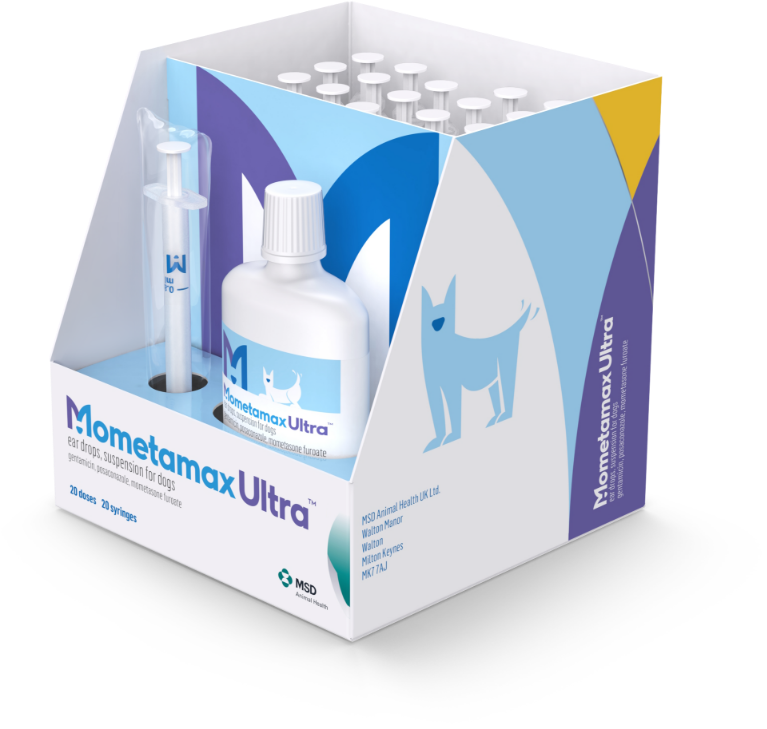
The multi-dose bottle of MOMETAMAX ULTRA contains sufficient product and syringes to treat 20 ears. The multi-dose bottle with syringes minimises inventory and shelf space. Add MOMETAMAX ULTRA to your portfolio of otitis externa medications.
References: 1. European Medicines Agency. Mometamax Ultra: EPAR – Product Information & Public Assessment Report. 2022. 2. Paterson S. J Small Anim Prac. 2016;57:668-678. 3. Bourely C, Cazeau G, Jarrige N, et al. Epidemiol Inf. 2019;147:1-10. 4. Peano A, Johnson E, Chiavassa E, et al. J Fungi. 2020;6:93. 5. Bourdeau P, Marchand AM, Etore F. Vet Dermatol. 2004;15:46.